Why lithium prices are rising again and what that means for battery costs

From
Hidde Huijssoon
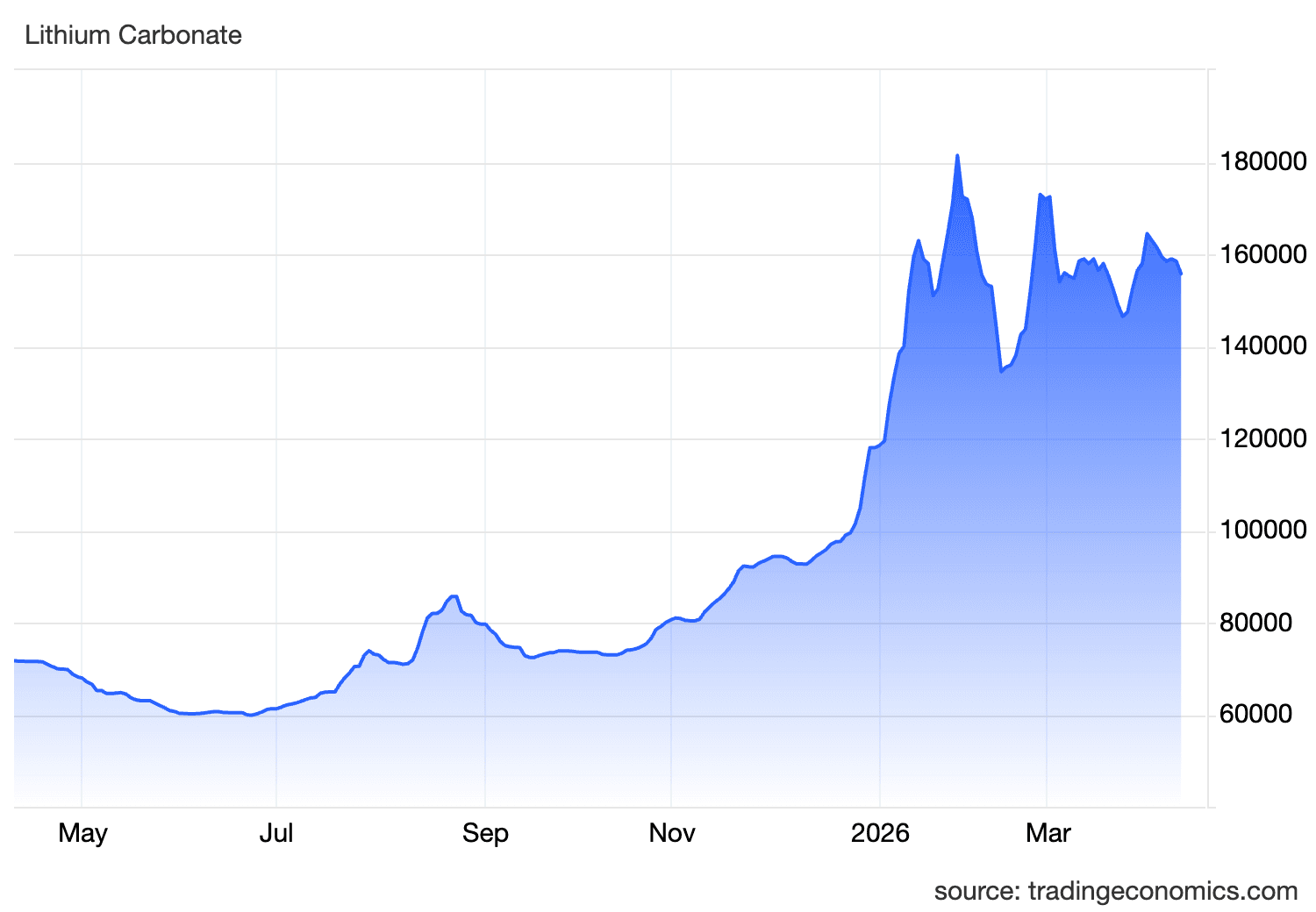
Lithium has become one of the most volatile commodities in the energy transition. After a dramatic boom-and-bust cycle that changed the battery industry, prices are climbing sharply again in 2025–2026. For anyone investing in or specifying battery energy storage systems, understanding what drives these swings and what protects against them is increasingly essential. Track current lithium prices on Trading Economics.
The boom: when lithium became the new oil
Between 2021 and late 2022, lithium carbonate prices increased roughly tenfold. The catalyst was a simultaneous surge in EV demand across China, Europe, and North America, colliding with a supply chain that had not anticipated anything close to that pace of growth. Mines take years, often over a decade, to develop, and refining capacity was almost entirely concentrated in China. Producers could not respond quickly enough. Battery manufacturers scrambled for feedstock, bidding prices to levels the market had never seen.
The impact on battery costs was direct and severe. New cell prices rose. EV manufacturers struggled to hold sticker prices stable, and grid-scale storage projects faced procurement delays as costs spiked unpredictably.
The Crash: oversupply and the race to the bottom
By 2023, the correction came. New mines had been approved at the peak, and their output arrived into a market where EV demand growth had slowed and buyers had overstocked. Chinese lithium prices fell nearly 90% from their 2022 high by mid-2025, one of the fastest collapses in commodity market history.
The crash had mixed consequences. Battery pack prices finally fell below $100/kWh, a long-awaited milestone. As manufacturers absorbed cheaper inputs, it also triggered a wave of mine suspensions and project cancellations. Across Australia, Chile, and Africa, it quietly removed supply that the market would be needed later.
The new surge: what is driving the 2025–2026 price recovery
Supply disruptions are stacking up
Several significant events have combined to tighten supply rapidly. China's CATL suspended a major lithium mine in Jiangxi province. Zimbabwe imposed an export ban on raw lithium concentrate. Chinese regulators cancelled dozens of mining permits as part of a campaign against below-cost production. Each event alone would have been manageable; together, they removed a meaningful share of available feedstock within a short window.
Demand from energy storage is now a primary driver
The demand picture has also shifted. Battery energy storage systems (BESS) for the electricity grid, are now one of the fastest-growing consumers of lithium globally. As solar and wind capacity expands, storage demand is accelerating alongside it. Lithium is no longer just an EV story. Read more on energy storage's role in the energy transition
The market has flipped from surplus to deficit
The result is a market that analysts expect to move into deficit in 2026, the first meaningful shortfall in several years. Prices have recovered sharply. Forecasts vary, but further volatility is widely anticipated as long as the structural bottlenecks in the lithium supply chain remain unresolved.
How this affects battery pricing
The relationship between lithium prices and battery pack costs can be seen but buffered. The industry has adapted since 2022: manufacturers now hedge through long-term supply contracts, the shift toward LFP chemistry has diversified cost exposure, and production efficiency continues to improve.
However, a sustained lithium demand will eventually test those buffers. Every meaningful increase in raw material costs adds pressure on cell manufacturers, which ripples through to integrators and end customers. Particularly in project-scale storage where procurement timelines stretch over months. The risk is not an overnight shock in pricing, but a gradual disappearance of the cost improvements that have made BESS increasingly viable across commercial and residential applications.
The structural problem: supply cannot respond quickly
The deeper issue is geological and political. Bringing a new lithium mine from discovery to production takes an average of over a decade globally. Refining capacity outside China is limited and slow to build. Even if prices signal clear demand for new supply, the physical response is years away. This is why price spikes tend to be sharper and more prolonged than the underlying demand shift would suggest.
Second-life batteries: a structural hedge against lithium volatility
One of the most effective responses to lithium price risk is to avoid new lithium entirely. Second-life battery energy storage systems, built from e.g. retired EV battery packs that still hold significant capacity, bypass the lithium supply chain at the point of greatest cost exposure: cell manufacturing.
When an EV battery retires, it typically retains 70–80% of its original capacity. Repurposing these packs for stationary storage applications, commercial buildings, solar self-consumption, grid services, extends their useful life without requiring new mining, refining, or cell production. The cost advantage over new cells is significant, and it is structurally insulated from commodity price swings.
Modual's second-life BESS systems are built on exactly this principle. Rather than depending on new cell production and the lithium supply chain that feeds it, Modual sources retired (EV) batteries, remanufactures and certifies them into professional-grade storage systems for residential and commercial applications. As lithium prices rise, the value proposition of this approach strengthens, as the input cost is decoupled from manufacturing price volatility. Learn more about second-life energy storage.
The broader industry is recognising this strategy. Second-life BESS deployments are scaling globally, and analysts project strong growth in the segment through the end of the decade as EV battery retirements scale over time.
Conclusion: volatility is the new normal
The lithium price cycle of 2021–2026 is not a one-time happening. It reflects the structural tension between a demand curve driven by policy and decarbonisation targets, and a supply chain constrained by geology, geopolitics, and long development timelines. That tension is unlikely to resolve quickly.
For commercial and residential energy storage buyers, the practical takeaway is straightforward: sourcing strategies that reduce dependence on new lithium cells offer more predictable costs and greater resilience over a project's lifetime. Second-life systems like those offered by Modual represent one of the clearest paths to that resilience available today.
Interested in a storage solution that isn't directly exposed to lithium price volatility? Get in touch with Modual or explore our knowledge base to learn how second-life BESS works in practice.